

Every year on October 10, people around the world recognize World Mental Health Day. For mental health professionals, the day offers more than an opportunity to share a graphic on social media or remind others that mental health matters. It provides an opportunity to consider how mental health care has evolved, where significant gaps remain, whose voices influence the systems we have created, and what responsibility each of us carries in making those systems better.
For emerging therapists, those questions are particularly important. Graduate school teaches us theories, interventions, ethics, assessment, diagnosis, case conceptualization, and treatment planning. Fieldwork gradually teaches us what it means to sit with another person's experience. But becoming a mental health professional also means entering a much larger global movement that has spent decades working to reduce stigma, improve access to care, protect dignity, advocate for human rights, and change how the world understands mental health.
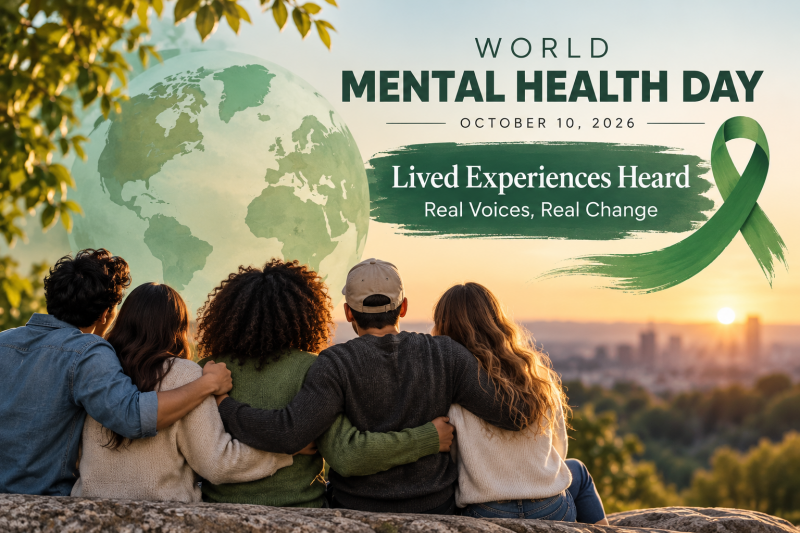
The 2026 World Mental Health Day theme, "Lived Experiences Heard: Real Voices, Real Change," asks us to consider an especially important part of that movement: whether people with lived experience are simply receiving mental health services or are actually being heard as we design those services, policies, organizations, and communities. WMHD Official
For emerging therapists, there may be no better time to begin thinking about what that distinction means.
A Brief History of World Mental Health Day
World Mental Health Day was first observed on October 10, 1992. It was established by the World Federation for Mental Health, with then-Deputy Secretary-General Richard Hunter playing an instrumental role in its creation. From its beginning, the purpose was international in scope: to increase public education about mental health, bring attention to important mental health issues, encourage advocacy, and create a unified opportunity for action around the world. World Federation for Mental Health
The organization behind the observance has an even longer history. The World Federation for Mental Health was founded in 1948 following World War II, with a vision that extended beyond treating mental illness to promoting mental health more broadly across biological, medical, educational, and social dimensions. The Federation began with member societies from 46 countries and today maintains members and contacts across more than 90 countries. World Federation for Mental Health
Over the decades, World Mental Health Day has developed into a global platform for focusing attention on different dimensions of mental health. Recent themes have addressed mental health as a universal human right, mental health in the workplace, mental health in humanitarian emergencies, suicide prevention, psychological first aid, dignity, access to care, and making mental health and well-being a global priority. The World Health Organization describes the overall objective of October 10 as raising awareness of mental health issues throughout the world and mobilizing efforts in support of mental health. World Health Organization
That history matters because the global conversation about mental health has never been static. How societies understand mental illness, treatment, recovery, stigma, institutionalization, community care, human rights, and the voices of people receiving services has continued to evolve.
The 2026 theme reflects another important step in that evolution.
Lived Experiences Heard: Real Voices, Real Change
This year's theme deserves more than a passing acknowledgment.
The World Federation for Mental Health explains that meaningful progress in mental health requires close collaboration with people who have lived experience. The organization points to a history in which people living with mental health conditions have experienced stigma, discrimination, social exclusion, barriers to care, and systems in which decisions about policies and services were sometimes made without sufficient participation from the people most directly affected by those decisions. WMHD Official
That creates an important distinction between speaking about people and speaking with them.
Mental health professionals possess specialized knowledge. Our education matters. Clinical research matters. Evidence-based and evidence-informed practice matters. Professional ethics matter. Diagnosis, assessment, treatment planning, and clinical judgment matter. None of those should be diminished.
But professional expertise does not replace lived experience.
Someone can understand the diagnostic criteria for major depressive disorder without knowing what it feels like to try to get through a workday while experiencing it. A therapist can understand substance use disorder from a clinical perspective without knowing what it is like to encounter stigma while seeking treatment. A clinician can study trauma without personally knowing what it means to tell a deeply painful story and wonder whether the person listening truly believes you. We can study barriers to mental health care without experiencing the frustration of calling provider after provider and discovering that no one is accepting new clients, accepts your insurance, speaks your language, understands your culture, or lives anywhere near your community.
Clinical knowledge helps us understand. Lived experience helps us understand differently. Strong mental health systems need both.
What World Mental Health Day Means Globally
It can be easy to think about mental health primarily through the lens of our own communities. World Mental Health Day intentionally asks us to broaden that perspective.
Access to mental health care is not distributed equally across the world. Mental health is influenced not only by diagnosis or individual psychology but also by poverty, displacement, conflict, discrimination, social isolation, education, employment, housing, community resources, health systems, and other social conditions. The World Federation for Mental Health's 2026 message specifically encourages attention to the social factors that influence mental health and calls for greater inclusion, opportunity, and participation in community life. WMHD Official
This is one reason a global observance matters. Mental health cannot be understood only as something that happens inside an individual person. People exist within families, communities, cultures, economic systems, health systems, and political and social environments. Those environments can support mental well-being, create barriers to it, or sometimes do both simultaneously.
World Mental Health Day gives countries, organizations, communities, professionals, advocates, families, and people with lived experience a common date around which those conversations can occur. It also reminds us that improving mental health worldwide cannot be accomplished by therapists alone. It requires collaboration among health professionals, educators, policymakers, community organizations, advocates, families, peers, and people who have directly experienced mental health challenges.
The 2026 campaign makes that collaboration particularly explicit. WFMH is encouraging organizations around the world to create events centered on lived experience and to provide genuine platforms through which those voices can influence services, policies, and communities. WMHD Official
From Hearing Voices to Sharing Power
There is also a larger challenge contained within the phrase "Real Voices, Real Change."
Listening is important, but listening without allowing what we hear to influence anything can become performative.
If organizations invite people with lived experience to speak but never incorporate their perspectives into services, policies, training, or decision-making, their voices may technically have been heard without actually producing change. The WFMH's 2026 message emphasizes moving beyond that limitation by creating genuine platforms for people with lived experience and allowing those experiences to shape better policies, services, and more inclusive communities. WMHD Official
This is relevant for emerging therapists because many of you will eventually occupy positions where you influence systems. You may become clinical supervisors, faculty members, clinical directors, practice owners, program administrators, researchers, consultants, or advocates. You may help write policies, design treatment programs, supervise clinicians, create intake procedures, establish documentation requirements, or determine how clients access services.
The habits you develop now can influence how you lead later.
If you learn early in your career to value the voices of the people receiving mental health services, you are more likely to carry that value into the systems you eventually help create.
Getting Involved Does Not Require a Large Platform
One of the most important messages I would offer emerging therapists this World Mental Health Day is simple: get involved in whatever way you realistically can.
Advocacy does not always require a microphone, a large social media following, or a leadership title. It can begin locally and quietly.
You might attend a World Mental Health Day event in your community, participate in a professional organization's activity, share reputable mental health information, volunteer with a local organization, learn more about the barriers affecting mental health care where you live, or support an organization doing work that matters to you. You might spend time learning from peer-support organizations or advocates with lived experience. You could encourage conversations about mental health in your workplace, university, internship site, or professional network.
You can also become involved simply by becoming a better listener.
Pay attention when clients describe what has and has not helped them in previous treatment. Listen when people with lived experience identify problems within mental health systems. Notice whose voices are present in professional conversations and whose are missing. Seek out perspectives that challenge assumptions you may have developed through textbooks, classrooms, or even clinical practice.
For those who want to participate more directly in the 2026 global campaign, the official World Mental Health Day website provides campaign information, events, WHO resources, and the WFMH 2026 toolkit intended to help individuals and organizations participate in the October 10 observance. WMHD Official
Explore World Mental Health Day 2026
What Emerging Therapists Can Carry Forward
World Mental Health Day lasts one day. The principles behind it should not.
For emerging therapists, October 10 can be an opportunity to think beyond assignments, clinical hours, graduation requirements, supervision, and licensure. Those things understandably occupy a tremendous amount of attention during the early stages of professional development. But you are also entering a profession with a history, a global presence, and an ongoing responsibility to improve how people experiencing mental health challenges are understood and treated.
This year's theme provides an especially valuable reminder that becoming a therapist is not only about developing your own clinical voice.
It is also about learning when your voice should not be the loudest one in the room.
The people we serve bring knowledge into the therapeutic relationship that cannot be obtained from a textbook. Their experiences can help us understand where systems fail, where services create unintended barriers, where language stigmatizes, where policies exclude, and where clinicians sometimes misunderstand despite good intentions. If we are willing to hear those experiences with humility, they can make us better therapists.
They can also make our mental health systems better.
Reflection Questions for Emerging Therapists
As you recognize World Mental Health Day this October 10, consider how much space lived experience currently occupies in your developing professional identity. When a client's understanding of their experience differs from your clinical conceptualization, how do you hold both perspectives? How do you distinguish between listening to someone's story and interpreting that story through your professional training? Whose perspectives have influenced how you understand mental health, and whose perspectives might still be missing?
You might also consider what involvement could realistically look like at this stage of your career. There is no requirement that advocacy look the same for every counselor. Your contribution might involve education, community service, professional advocacy, research, volunteering, reducing stigma, supporting access to care, amplifying lived experience, or simply becoming more intentional about how you listen to the people you serve.
The important part is recognizing that you have a place in this work.
Closing Thoughts
World Mental Health Day began in 1992 with an ambitious idea: create a day when the world could speak collectively about mental health and use that conversation to promote awareness, education, advocacy, and change. More than three decades later, October 10 continues to provide that opportunity. World Federation for Mental Health
The 2026 theme, "Lived Experiences Heard: Real Voices, Real Change," challenges us to move beyond simply raising awareness. It asks us to consider who participates in conversations about mental health, whose knowledge we value, and whether listening actually leads to change.
For emerging therapists, that challenge begins long before independent licensure. It begins in classrooms, supervision, practicum, internship, and the therapy room. It begins with curiosity about experiences different from our own and humility about the limits of professional knowledge. It continues when we become supervisors, educators, leaders, advocates, and experienced clinicians.
On October 10, I encourage you to find some way to participate. Learn something. Attend something. Share something credible. Support an organization. Listen to someone whose lived experience differs from your own. Start a conversation in your community or professional network.
You do not need to change the entire mental health system to contribute to change.
But as emerging therapists, we should all be willing to help move it forward.
Author: Steven Glasser, PhD.
References
World Federation for Mental Health. (n.d.). History of the World Federation for Mental Health. World Federation for Mental Health
World Federation for Mental Health. (2022). World Mental Health Day 2022 report. World Mental Health Day 2022 report
World Federation for Mental Health. (2026). World Mental Health Day 2026: Lived experiences heard: Real voices, real change. World Mental Health Day 2026
World Federation for Mental Health. (2026). Message from the WFMH. World Mental Health Day 2026 WFMH message
World Health Organization. (n.d.). World Mental Health Day. World Health Organization: World Mental Health Day
Add comment
Comments